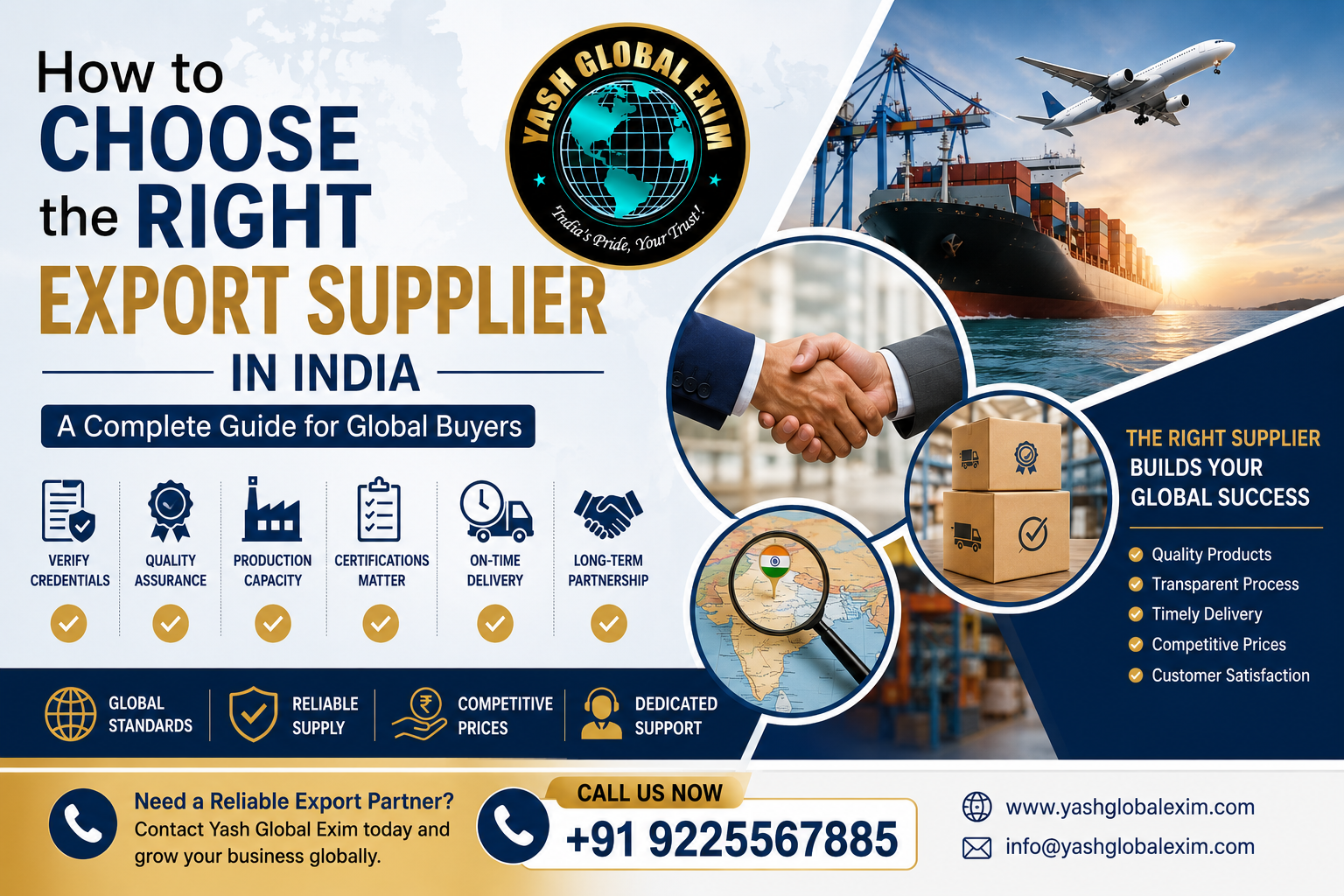
How to Choose the Right Export Supplier in India
India has become one of the world’s most trusted manufacturing and export hubs. From agricultural products and spices to engineering goods, textiles, chemicals, pharmaceuticals, handicrafts, and industrial machinery, Indian exporters serve businesses across more than 200 countries.
However, finding the right export supplier in India is one of the most important decisions for any importer. The success of your international business depends on product quality, timely deliveries, transparent communication, competitive pricing, and compliance with international standards. Choosing the wrong supplier can result in delayed shipments, inconsistent product quality, financial losses, and damaged customer relationships.
Whether you are importing products for the first time or looking to switch suppliers, this comprehensive guide will help you understand how to evaluate, verify, and select a reliable export supplier in India.
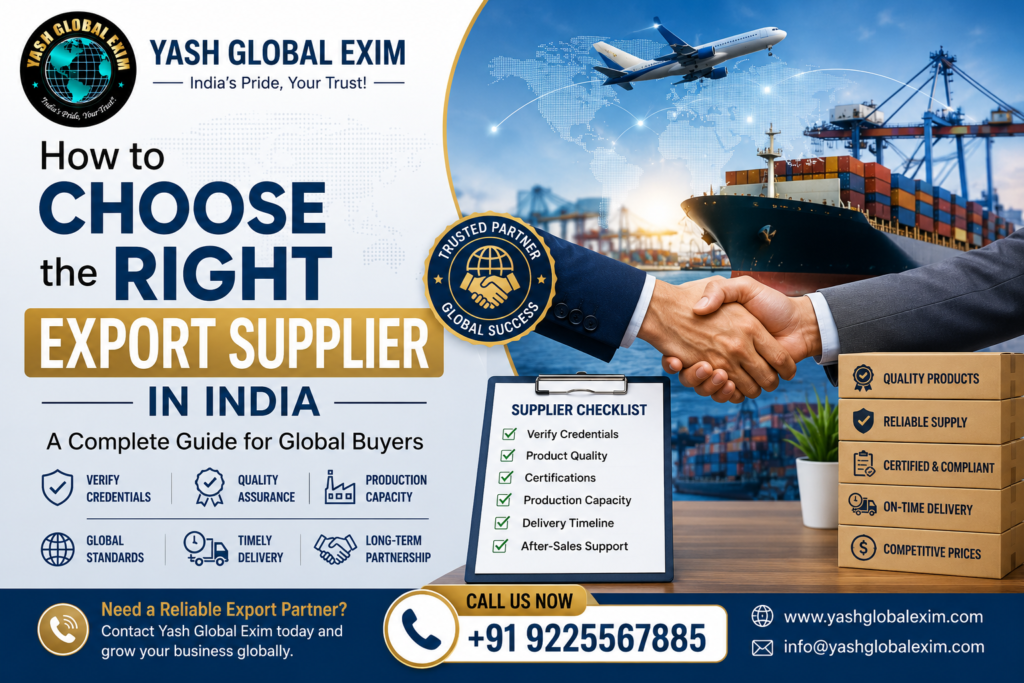
Table of Contents
- Why India is a Global Export Hub
- Why Choosing the Right Export Supplier Matters
- Understand Your Business Requirements First
- Types of Export Suppliers in India
- How to Verify an Export Supplier
- Questions to Ask Before Finalizing a Supplier
- Certifications to Check
- Red Flags to Avoid
- Building Long-Term Supplier Relationships
- Final Checklist
- Frequently Asked Questions
Why India is One of the Best Countries for Global Sourcing
India has established itself as one of the fastest-growing export economies. With a strong manufacturing ecosystem, skilled workforce, government support for exports, and competitive pricing, businesses around the world rely on Indian suppliers for high-quality products.
Some of the biggest advantages of sourcing products from India include:
Wide Product Range
India exports thousands of products across industries, including:
- Agricultural Products
- Fresh Fruits & Vegetables
- Spices
- Rice
- Tea & Coffee
- Engineering Goods
- Industrial Machinery
- Chemicals
- Pharmaceuticals
- Medical Equipment
- Textiles
- Garments
- Leather Products
- Furniture
- Handicrafts
- Food Products
- Organic Products
- Packaging Materials
This diversity allows international buyers to source multiple products from a single country.
Competitive Pricing
One of the biggest reasons global buyers choose Indian exporters is cost efficiency.
Indian manufacturers often provide:
- Competitive manufacturing costs
- Affordable labor
- Flexible production capacity
- Bulk order discounts
- Better profit margins for importers
Lower production costs do not necessarily mean lower quality. Many Indian exporters manufacture products according to international standards while maintaining competitive pricing.
Strong Manufacturing Infrastructure
India has thousands of export-oriented manufacturing units equipped with advanced technology and modern production facilities.
Many suppliers invest in:
- Automated production
- Advanced quality control
- International certifications
- Research and development
- Modern packaging solutions
These capabilities help Indian exporters meet the expectations of international buyers.
Government Support for Exporters
The Government of India encourages exports through various initiatives, including:
- Export promotion schemes
- Trade fairs
- Export incentives
- Digital trade platforms
- Infrastructure development
- Simplified export procedures
This support has strengthened India’s position as a preferred sourcing destination.
Why Choosing the Right Export Supplier Matters
Many businesses focus only on price when selecting a supplier. However, the cheapest supplier is not always the best choice.
A reliable export supplier becomes a long-term business partner who contributes to your company’s growth.
The right supplier ensures:
Consistent Product Quality
Quality consistency is essential for maintaining customer satisfaction and protecting your brand reputation.
Reliable suppliers follow standardized manufacturing processes and implement strict quality inspections before shipment.
Timely Delivery
Late shipments can lead to:
- Lost customers
- Inventory shortages
- Production delays
- Increased logistics costs
- Financial penalties
Professional exporters have efficient production planning and logistics management systems to ensure on-time delivery.
Transparent Communication
International trade requires clear communication regarding:
- Product specifications
- Packaging requirements
- Production timelines
- Shipping schedules
- Payment terms
- Documentation
An experienced exporter communicates proactively and responds promptly to buyer inquiries.
Compliance with International Standards
Reliable exporters understand the regulatory requirements of different countries.
They ensure products comply with:
- Import regulations
- Product safety standards
- Packaging requirements
- Labeling regulations
- Quality certifications
- Customs documentation
This minimizes the risk of shipment rejection or customs delays.
Long-Term Business Growth
Building a long-term relationship with the right supplier offers several benefits:
- Better pricing over time
- Priority production during peak seasons
- Customized products
- Faster communication
- Improved payment flexibility
- Stronger business trust
Instead of constantly searching for new suppliers, businesses can focus on expanding their markets.
Step 1: Understand Your Business Requirements Before Searching for a Supplier
Before contacting any exporter, define your requirements clearly.
This will help you shortlist suppliers that match your business needs.
Product Specifications
Prepare detailed product specifications, including:
- Product name
- Dimensions
- Material
- Grade
- Color
- Packaging
- Labeling
- Quantity
- Technical requirements
The more detailed your requirements, the easier it becomes for suppliers to provide accurate quotations.
Quantity Requirements
Suppliers need to know your expected order volume.
Determine whether you require:
- Sample orders
- Small batch orders
- Regular monthly orders
- Annual contracts
- Bulk container shipments
Some manufacturers specialize in large-scale production, while others are better suited for smaller orders.
Quality Standards
Clearly communicate your expected quality level.
For example:
- Food Grade
- Pharmaceutical Grade
- Industrial Grade
- Organic Certification
- ISO Standards
- Customer-specific standards
Providing quality expectations at the beginning reduces misunderstandings later.
Target Market
Export requirements differ depending on the destination country.
Mention where the products will be shipped.
Examples:
- USA
- Canada
- United Kingdom
- Germany
- Australia
- UAE
- Saudi Arabia
- South Africa
- Singapore
Different markets require different compliance standards.
Budget Planning
Avoid choosing suppliers based only on the lowest quotation.
Consider the total cost, including:
- Product cost
- Packaging
- Inland transportation
- Export documentation
- Freight charges
- Insurance
- Customs duties
- Inspection fees
A slightly higher supplier price may offer better quality, fewer defects, and lower long-term costs.
Step 2: Understand the Different Types of Export Suppliers in India
Not all exporters operate in the same way. Understanding the different supplier types helps you choose the best partner for your business.
1. Manufacturers
Manufacturers produce goods in their own factories.
Advantages include:
- Better pricing
- Product customization
- Direct communication
- Higher production capacity
- Better quality control
Manufacturers are often the best option for businesses placing regular or bulk orders.
2. Merchant Exporters
Merchant exporters source products from multiple manufacturers and export them under their own company.
They are ideal when buyers need:
- Multiple product categories
- Smaller quantities
- Simplified sourcing
- One-point coordination
Merchant exporters save buyers time by managing supplier coordination and export documentation.
3. Trading Companies
Trading companies connect buyers with manufacturers and handle procurement, quality checks, logistics, and shipping.
They are particularly useful for companies that do not have a local sourcing team in India.
Trading companies can also help buyers identify reliable manufacturers, negotiate prices, and manage the export process efficiently.
Step 3: How to Verify an Export Supplier in India
Selecting an export supplier should never be based only on an attractive quotation or a professional-looking website. A reliable supplier should be verified thoroughly before you place your first order. Proper verification reduces business risks and helps build long-term partnerships.
1. Verify the Company’s Legal Registration
The first step is to confirm that the supplier is a legally registered business.
Ask for details such as:
- Company Registration Certificate
- Import Export Code (IEC)
- GST Registration
- PAN Card
- Business Address
- Factory Address (if applicable)
A genuine exporter will have no hesitation in sharing these details.
2. Check Industry Experience
Experience is an important indicator of reliability. Companies with several years of export experience generally have better systems, quality control, and international trade knowledge.
Ask questions like:
- How many years have you been exporting?
- Which countries do you currently export to?
- What are your major export products?
- Can you share your export experience?
Experienced exporters are usually better equipped to handle documentation, customs requirements, and shipping challenges.
3. Review the Company’s Website
A professional website often reflects the credibility of a business.
While reviewing the supplier’s website, check for:
- Detailed product information
- Company profile
- Manufacturing capabilities
- Quality policy
- Certifications
- Factory images
- Contact information
- Client testimonials
- Export markets
- Inquiry forms
A well-maintained website demonstrates professionalism and transparency.
4. Check Online Presence
Reliable exporters maintain an active online presence.
Look for:
- LinkedIn Company Page
- Facebook Business Page
- YouTube Channel
- Google Business Profile
Regular updates, customer engagement, and professional content indicate an active and trustworthy business.
5. Read Customer Reviews
Reviews provide valuable insights into a supplier’s performance.
Pay attention to comments regarding:
- Product quality
- Delivery timelines
- Communication
- Packaging
- Customer service
- After-sales support
No company receives only perfect reviews, but consistently positive feedback is a good sign.
6. Request Product Samples
Never place a large order without evaluating samples.
Assess the sample for:
- Material quality
- Dimensions
- Weight
- Finish
- Packaging
- Durability
- Functionality
- Branding
Testing a sample helps identify issues before making a larger investment.
Step 4: Important Certifications to Check
Certifications demonstrate that a supplier follows recognized quality, safety, and compliance standards.
Depending on your industry, ask for relevant certifications.
ISO 9001
ISO 9001 indicates that the company follows a quality management system focused on consistent production and customer satisfaction.
FSSAI (Food Products)
If you are importing food products from India, ensure the supplier has the required food safety registration.
HACCP Certification
HACCP ensures food products are manufactured following internationally accepted food safety practices.
GMP Certification
Good Manufacturing Practices (GMP) certification is essential for pharmaceuticals, cosmetics, and healthcare products.
Organic Certifications
For organic products, verify certifications such as:
- NPOP
- USDA Organic
- EU Organic
APEDA Registration
Suppliers exporting agricultural and processed food products should be registered with APEDA where applicable.
Spice Board Registration
For spice exporters, Spice Board registration is an important credibility factor.
Export Inspection Certifications
Certain products require inspection and quality certification before export.
Always verify applicable compliance based on your product category and destination country.
Step 5: Questions Every Buyer Should Ask Before Finalizing a Supplier
Professional buyers ask detailed questions before confirming an order.
Production Capacity
Understanding production capacity helps ensure the supplier can fulfill your order volume consistently.
Questions to ask:
- What is your monthly production capacity?
- Can production be increased during peak demand?
- How many production lines do you operate?
Minimum Order Quantity (MOQ)
Every supplier has different MOQ requirements.
Clarify:
- Minimum order quantity
- Trial order availability
- Sample order policy
Some suppliers are flexible for first-time buyers.
Lead Time
Production time affects your supply chain.
Ask:
- Production lead time
- Packaging timeline
- Shipping preparation time
- Delivery schedule
Always build a buffer into your planning for unexpected delays.
Packaging Options
Packaging influences product protection and customer perception.
Discuss:
- Standard packaging
- Customized packaging
- Private labeling
- Export-grade cartons
- Palletization
Good export packaging reduces the risk of damage during international transit.
Shipping Methods
Ask which shipping options the supplier supports.
Examples:
- Sea Freight
- Air Freight
- Express Courier
- LCL Shipments
- Full Container Load (FCL)
The supplier should guide you in choosing the most cost-effective option.
Payment Terms
Understand payment conditions before signing any agreement.
Common payment methods include:
- Advance Payment
- Letter of Credit (LC)
- Telegraphic Transfer (TT)
- Documents Against Payment (D/P)
Avoid making 100% advance payments to new suppliers unless there is strong trust and verification.
Step 6: Factory Audit – Why It Matters
If your order value is significant, conducting a factory audit is highly recommended.
A factory audit allows you to verify whether the supplier can genuinely deliver what they promise.
During the audit, evaluate:
Manufacturing Facilities
Inspect:
- Machinery
- Production lines
- Factory size
- Maintenance standards
- Safety practices
Modern equipment generally results in better consistency and efficiency.
Workforce
Observe:
- Skilled workers
- Training standards
- Workforce size
- Production supervision
Experienced staff contribute to higher-quality products.
Quality Control System
Ask about:
- Incoming material inspection
- In-process quality checks
- Final inspection
- Testing procedures
A strong quality management system minimizes defects and returns.
Storage and Inventory
Well-organized warehouses indicate professionalism.
Check:
- Raw material storage
- Finished goods storage
- Cleanliness
- Inventory management
Proper storage protects product quality before shipment.
Step 7: Compare Multiple Suppliers Before Making a Decision
Avoid selecting the first supplier you find.
Shortlist at least three to five suppliers and compare them objectively.
| Evaluation Factor | Supplier A | Supplier B | Supplier C |
|---|---|---|---|
| Product Quality | ⭐⭐⭐⭐⭐ | ⭐⭐⭐⭐ | ⭐⭐⭐⭐⭐ |
| Pricing | Medium | Low | High |
| Delivery Time | Fast | Medium | Fast |
| Certifications | Excellent | Good | Excellent |
| Communication | Excellent | Average | Very Good |
| Packaging | Excellent | Good | Very Good |
| Experience | 15 Years | 6 Years | 10 Years |
| Export Countries | 40+ | 18 | 32 |
A structured comparison helps you choose the supplier that offers the best overall value rather than simply the lowest price.
Step 8: Evaluate Communication and Professionalism
Strong communication is essential in international trade.
A reliable supplier should:
- Respond promptly to emails and inquiries.
- Provide clear and detailed quotations.
- Be transparent about pricing and lead times.
- Inform you immediately about any production or shipping delays.
- Offer practical solutions to unexpected challenges.
Professional communication builds confidence and helps prevent costly misunderstandings.
Step 9: Negotiate Smartly Without Compromising Quality
Negotiation is a normal part of international business, but it should focus on long-term value rather than just reducing the price.
Instead of asking only for discounts, consider negotiating:
- Better payment terms
- Improved packaging
- Faster production schedules
- Free product samples
- Lower MOQ for initial orders
- Additional quality inspections
- Better shipping support
A collaborative approach often leads to stronger supplier relationships and better overall business outcomes.
Step 10: Common Red Flags to Avoid When Choosing an Export Supplier
Choosing the wrong supplier can lead to delayed shipments, poor product quality, financial losses, and damaged customer relationships. Before signing any agreement, watch out for these warning signs.
1. Prices That Are Too Good to Be True
If a supplier offers prices significantly lower than the market average, investigate carefully.
Extremely low prices may indicate:
- Poor quality raw materials
- Hidden charges
- Inexperienced manufacturers
- Low production standards
- Fraudulent business practices
Instead of choosing the cheapest supplier, focus on overall value, consistency, and reliability.
2. Lack of Business Documentation
A professional export company should willingly provide:
- Company Registration
- Import Export Code (IEC)
- GST Registration
- Product Certifications
- Factory Information
If a supplier avoids sharing these documents, consider it a major warning sign.
3. Poor Communication
Reliable exporters respond professionally and promptly.
Be cautious if the supplier:
- Takes several days to reply
- Gives incomplete answers
- Frequently changes information
- Avoids technical discussions
- Ignores your questions
Communication is one of the strongest indicators of future business performance.
4. No Product Samples
Never place a bulk order without testing product samples.
A trustworthy exporter understands the importance of product evaluation and is generally willing to provide samples before large orders.
5. Unrealistic Delivery Promises
Some suppliers promise impossible production timelines simply to win business.
Ask for realistic schedules covering:
- Production
- Quality inspection
- Packaging
- Shipping
- Documentation
Reliable exporters always provide achievable timelines rather than unrealistic commitments.
6. No Quality Control Process
Ask every supplier:
- How do you inspect raw materials?
- How many quality checks are conducted?
- Do you inspect products before shipment?
If there is no structured quality control system, product consistency may become a serious issue.
Step 11: Build a Long-Term Partnership Instead of Looking for One-Time Orders
The most successful importers do not change suppliers every few months.
Instead, they develop long-term partnerships built on trust, consistency, and mutual growth.
Benefits include:
- Better pricing
- Priority production
- Faster communication
- Flexible payment terms
- Customized products
- Improved quality consistency
- Better planning during peak seasons
Treat your supplier as a strategic business partner rather than just a vendor.
Step 12: Export Supplier Evaluation Checklist
Use this checklist before finalizing any export supplier.
| Evaluation Criteria | Status |
|---|---|
| Company Registration Verified | ✅ |
| IEC Available | ✅ |
| GST Verified | ✅ |
| Product Samples Approved | ✅ |
| Factory Verified | ✅ |
| Certifications Checked | ✅ |
| Quality Control Process Reviewed | ✅ |
| Communication Satisfactory | ✅ |
| Production Capacity Confirmed | ✅ |
| Delivery Timeline Confirmed | ✅ |
| Payment Terms Agreed | ✅ |
| Export Experience Verified | ✅ |
| Packaging Approved | ✅ |
| Shipping Method Finalized | ✅ |
| Long-Term Supply Capability Confirmed | ✅ |
If most boxes are checked, you are likely working with a reliable export partner.
Why Choose Yash Global Exim?
Choosing the right export partner is just as important as choosing the right product.
At Yash Global Exim, we are committed to helping international buyers source high-quality products from India with complete transparency and professionalism.
Our Strengths
- Reliable Global Export Solutions
- Strict Quality Control
- Competitive Pricing
- Timely Delivery
- International Standard Packaging
- Customized Export Solutions
- Experienced Export Team
- Transparent Communication
- Customer-Centric Approach
- Long-Term Business Partnerships
Whether you are importing agricultural products, food products, industrial goods, engineering products, or customized solutions, our team is dedicated to making your sourcing process smooth and reliable.
Final Thoughts
India continues to be one of the world’s most trusted sourcing destinations, offering a diverse range of products, competitive pricing, skilled manufacturers, and strong export infrastructure.
However, the success of your import business depends largely on selecting the right export supplier. A thorough evaluation of a supplier’s experience, certifications, quality standards, production capabilities, communication, and compliance can save your business from unnecessary risks.
Take the time to verify credentials, request product samples, compare multiple suppliers, and build long-term relationships based on trust. By following the steps outlined in this guide, you can confidently choose an export partner that supports your business growth and ensures a reliable supply chain.
When you work with the right supplier, you gain more than products—you gain a dependable business partner for long-term success.
Frequently Asked Questions (FAQs)
1. How do I know if an export supplier in India is genuine?
Verify the company’s registration, Import Export Code (IEC), GST registration, certifications, website, online presence, customer reviews, and request product samples before placing an order.
2. What certifications should I check before importing from India?
Depending on the product category, look for certifications such as ISO 9001, HACCP, GMP, FSSAI, APEDA, Organic Certifications, and other industry-specific approvals.
3. Is it necessary to visit the supplier’s factory?
For high-value or long-term business partnerships, a factory visit or third-party factory audit is highly recommended to verify manufacturing capabilities and quality standards.
4. Should I always choose the supplier offering the lowest price?
No. The lowest price may come with compromises in quality, packaging, delivery timelines, or customer service. Evaluate suppliers based on overall value rather than price alone.
5. What documents should an Indian export supplier provide?
A reliable supplier should be able to provide company registration documents, IEC, GST registration, certifications, product specifications, quality reports, and export documentation.
6. How important are product samples before placing a bulk order?
Product samples are essential. They allow you to evaluate quality, packaging, dimensions, finish, and compliance before making a larger investment.
7. What is the best way to build a long-term relationship with an export supplier?
Maintain clear communication, honor agreed payment terms, provide constructive feedback, and work collaboratively to achieve mutual business growth.
Call to Action
Looking for a Reliable Export Supplier in India?
If you’re searching for a trusted export partner, Yash Global Exim is here to help. We provide high-quality products, transparent business practices, and dependable export solutions tailored to your requirements.
Contact our team today to discuss your sourcing needs and discover how we can support your international business with reliable products, competitive pricing, and timely deliveries.